Decoy ponds in Essex
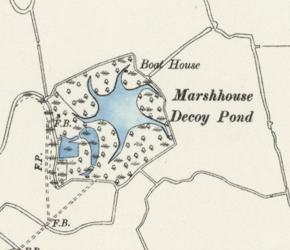 Situated on the Tillingham Marshes at the eastern end of the
Dengie Peninsula is an unusual and important historic monument. When viewed
from the nearby footpath, the location of the monument is marked by a small and
dense forest. But the forest hides a star-shaped pond, which begins to reveal
itself on the modern Ordnance Survey (OS) map. It’s true extent is best
represented on the historic OS map, which illustrates the six original ‘arms’
that fan out from the centre of the pond and curve around the feature in a
clockwise direction.
The pond is Marsh House Decoy (EHER 37), an 18th century decoy pond used to catch wildfowl (ducks), and a Scheduled Ancient Monument. It is one of 48 ponds of this type recorded by the EHER, and one of 30 that are known in Maldon District alone.
What is a decoy pond?
Decoy ponds are thought to date from the medieval period. They may have originated in their current form from Holland and were introduced to England in the 17th century. Historic England describes decoy ponds as:
“…artificially created or modified pools of water onto which wildfowl were lured to be trapped and killed for food and for feathers. They consist of a central pool off which lead a number of curving arms or ditches, known as pipes. Nets were constructed over the narrowing ends of these pipes towards which the birds were lured by the decoyman and his dog.” 1
What makes Marsh House decoy special?
Marsh House decoy is a well-preserved example of a decoy pond and, unlike many other ponds in Essex, the documentary evidence for the yearly ‘takings’ of the pond survives similarly well. The documents describe the types of duck caught, how much profit was made each year, and the names of the decoyman, tenants and landowners from 1795 onwards (including the Rev. Sir Henry Bate Dudley as tenant in 1797). It is therefore one of the most well-documented decoy ponds in the county. From these documents we can learn that the number of birds caught was far greater in the earlier period of its use than in later days. For example, an article in the Essex Naturalist (the Journal of the Essex Field Club) records:
“…10,000 Wigeon, Teal and Wild Duck were taken in 1799; from 1852-53 to 1856-57 a total of 11,041, averaging 2,208 per annum, was taken… from 1859-60 to 1864-65 the average annual catch was 3,500, then dropped to about 2,500 and about 1890 the numbers had fallen to about 2,000.” 2
There appears to have been a working relationship between this and the neighbouring Grange Decoy (EHER 2066), approximately 1.5km to the north. One pond would keep the lead in the number of Wigeon taken for several seasons and then the other would have its turn. Sometimes the ducks might desert one altogether in favour of the other.
Marsh House Decoy is also known to have continued in use into the early 20th century, further adding to its significance. It experienced a short break in use during the First World War and was still in use in 1943 when Glegg wrote the Essex Naturalist article. Also unique to Marsh House Decoy is the survival of the associated decoyman’s hut, which is included in the Scheduling.
Decoy ponds in Maldon and beyond
The Marsh House and Grange decoys are among 12 known decoy ponds on the Dengie Peninsula. The greatest concentration of decoy ponds in Essex is found along the northern bank of the River Blackwater from Heybridge to Tollesbury, where the EHER records 18 monuments (including one on Northey Island, EHER 7956). The marshy areas of the Tendring coast are also a common location for the ponds, with a further 14 records in this district. The most inland record is for the possible site of ‘Felstead Decoy’ (EHER 82225) which is situated near Leighs Priory in Felsted, Uttlesford. There are five Scheduled decoy ponds in the Essex HER (EHER 37, EHER 9996, EHER 11560, EHER 16282, EHER 16881).
To explore the records for decoy ponds in Essex, use the Advanced Search to refine by monument type ‘decoy pond’. Or follow this link.
Bibliography
- Decoypond 700m north east of Marsh House Farm, Tillingham - 1013835 | HistoricEngland
- Glegg, W., 1943-1944, The Duck Decoys of Essex, in Essex Naturalist XXVII, p.194