Witchcraft in Essex
Essex in the 16th and 17th centuries was the perfect breeding ground for the heightened paranoia of the witch craze. It was a marshy landscape with small, isolated communities, where people lived in extreme poverty, and disease was common. Law and order were upheld by the local landowners of power, but the most serious criminal and civil cases were tried at the Assizes in Chelmsford. Because doctors were too expensive and medical knowledge was scarce, local cunning women were sought out in the most perilous times: childbirth, illness, crop failure or sick livestock. Although cunning women were highly valued in villages, they were also vulnerable to accusations of maleficium, or magic used for evil, when things went wrong. Between 1560 and 1680, 317 women and 23 men were tried for witchcraft in Essex alone, and over 100 were hanged.
 Great Waltham
This is exactly what happened to Elizabeth Lowys, a cunning woman who lived in Great Waltham. In 1564, amid rising village tensions, she was brought before both church and civil courts. She was accused by neighbours (and eventually her own husband) of turning her magic against the community, specifically being blamed for the deaths of an infant named Robert Wodley and a child named John Canall. She was ultimately found guilty of "murder by magic" and hanged on Primrose Hill in Chelmsford – the first person to be executed under the Witchcraft Act 1562. The witness depositions are preserved at the Essex's Records office and offer one of the clearest surviving pictures of the community dynamics, rumours, and social tensions that shaped the case against her.
Hatfield Peverel
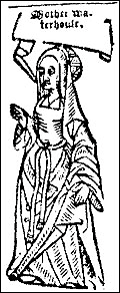
In 1566, three women from Hatfield Peverel were accused of witchcraft: Agnes Waterhouse, Elizabeth Frauncis and Joan Waterhouse. Agnes confessed to having a familiar and was subsequently tried for causing illness and killing both people and livestock. She subsequently became the second person to be executed for witchcraft in England in 1566.
Figure 1: A woodcut of Anges Waterhouse.
Canewdon
Three witchcraft trials occurred here within the short span of ten years. In 1580 the spinster Rose Pye was accused of bewitching to death Johanna Snow, a twelve-month-old child at Scaldhurst Farm. She pleaded not guilty and was acquitted but died in jail probably because she was unable to pay the fee needed to secure her release. In 1585, Cicily Makyn was also charged with practising witchcraft and given five years to mend her ways. In 1590 the ‘Goodwife’ Makins of Canewdon was indicted for witchcraft, as this trial occurs five years after the one involving Cicily Makyn it is safe to assume that they were one and the same, allowing for medieval flexibility with spelling. It appears that Cicily did not heed the warning to reform and as punishment was excommunicated.
There is a strong folkloric link between witches and the Church of St. Nicholas (EHER 34965) at Canewdon. One saying, recorded in the 19th century, states that so long as the steeple exists, there will always be six witches in Canewdon; and those who walk round the tower at midnight will be forced to dance with the witches. According to a later addition, when a village witch died, a stone always fell from the church wall (or vice versa – “every time a stone falls from the tower, one witch will die, and another will take her place”. Running seven times around a certain grave in the graveyard would also have supernatural consequence, making either witches or the Devil appear.
There is another local legend saying the crossroads where Anchor Lane, Scotts Hall Road, Lark Hill Road and the lane to the church meet is where a witch was buried, with a stake through her heart. Crossroads have been linked to the supernatural since at least the Anglo Saxons, seen as liminal spaces (spaces between worlds); and criminals and suicides were often hanged or buried there as punishment. Another example is north-east of the village of Finchingfield, on a grassy triangle where the roads to Finchingfield, Stambourne and Wethersfield meet.
A patch beside the river Crouch in the north of Canewdon parish has long been known as the ‘Witch’s Field’. A witch was said to have been buried there after drowning, and for long afterward it was thought no crop would succeed in growing there.
There was one person said to be more powerful than the witches of Canewdon - James Murrell, the cunning man of Hadleigh.
St Osyth
Ursula Kemp of St Osyth was another cunning woman who was accused of (and apparently confessed to) witchcraft in 1581; this time using familiars to kill and bring sickness to her neighbours. They consisted of two tomcats (Jack, a black cat and Tyttey, a grey cat), a female toad (Pigine), and a female lamb (Tyffin). They were divided by gender, with the males used to plague people to death and the females used to cause bodily harm. According to local legend, she was kept in The Cage of St Osyth, before being tried in Chelmsford. Even while imprisoned for her alleged crimes, members of the community continued to seek advice form Ursula. While she was being tried, she was misled to think that implicating other women would lead to her freedom. This meant that this became one of the largest early mass accusations in England, detailed in contemporary pamphlets. A skeleton found on Mill street in 1921 was theorised to be Kemp’s but it was found to be a man in 2011 (EHER 16178).
Felsted
Boote House (EHER 37046), built by George Boote in 1596 in the centre of Felsted, is a historic building featuring carved wooden brackets supporting its overhanging first floor. The most distinctive bracket depicts the Felsted Hag, a grotesque female figure with cloven hooves, traditionally believed to ward off evil. While local legend claims she represents Boote’s cursed wife, another modern tale says she comes to life on Halloween and walks the village streets.
Manningtree and Mistley
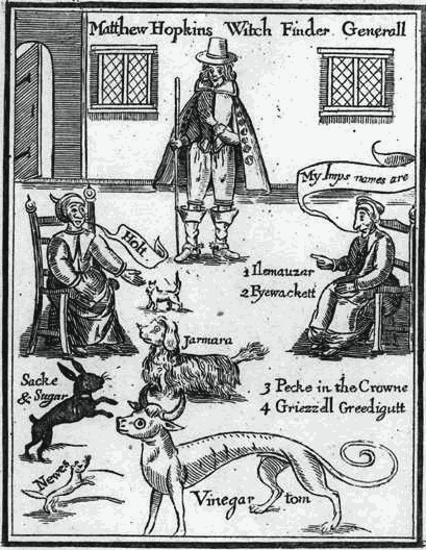
Figure 2: Frontispiece from Matthew Hopkins's The Discovery of Witches (1647), showing witches identifying their familiar spirits.
According to local legend, in 1644 Hopkins turned up in the town to buy the Thorn Inn in Mistley (EHER 34660) with money he had inherited from his late father, a puritan preacher by the name of John Hopkins. It was in Manningtree that Hopkins met John Stearne, who first accused a group of Manningtree women of witchcraft. Hopkins became his assistant and set out to find evidence, alleging to overhear women discussing their meetings with the Devil in March 1644. This started his short but vicious career as a witchfinder. In their fourteen months on the road, it is estimated Hopkins and Stearne were responsible for the deaths of between two and three hundred people - more than all the other witch-hunters in England of the previous 160 years.
Utilising the chaos of the Civil War, Hopkins and Stearne concocted their titles and credentials, and falsely claimed to have been appointed by Long Parliament to uncover and prosecute witches across East Anglia, charging extortionate fees to do so. He jailed and interrogated those he believed to be witches at Colchester Castle, where many are believed to have died as a result of their incarceration before even being brought to court. Although torture was nominally unlawful in England, Hopkins subjected the accused women to sleep deprivation and employed the services of ‘seekers’ - women who would search the accused's' bodies for what was known as the ‘Devil’s Mark’. If the suspected witch had no such visible marks invisible ones could be discovered by pricking. Therefore, ‘witch prickers’ were employed, who pricked the accused with knives and special needles looking for such marks, normally after the suspect had been shaved of all body hair. He would also cut the arm of the accused with a blunt knife, and if she did not bleed, she was said to be a witch. He would also employ methods such as the famous swimming test: suspects were tied to a chair and thrown into water: all those who ‘swam’ (floated) were considered to be witches; based on the idea that as witches had renounced their baptism, water would reject them. Standing on the little humpback of the Hopping Bridge (EHER 34676), you can look over at the still waters of the same pond that Hopkins used to test the witches of Mistley and Manningtree, and his ghost is said to haunt there. Even at the height of the witch craze, this ordeal was seen as too cruel and irrational, and Hopkins and Stearne were forced to discontinue by judicial authorities in 1645. Ducking stools are said to survive at Cage End, Hatfield Broad Oak (EHER 18754), Coggeshall (EHER 18442), Epping (EHER 18475) and Hutton (EHER 19122).
This was the start of the tide shifting against the witchfinders. John Gaule, vicar of Great Staughton in Huntingdonshire, objected to the methods the men used and began openly preaching against them in his sermons, and published a letter exposing their methods. This led to their official questioning during the spring of 1647 at the Norfolk Assizes in Norwich. Faced with mounting public resentment over his controversial methods and extortionate fees, as well as his own rapidly declining health, Hopkins disbanded his team and retired to Manningtree. Before his death in August 1647, he published his book The Discovery of Witches in May 1647, ensuring his legacy. He was buried at Church of St Mary at Mistley Heath (EHER 34662). Following the publication of Hopkins's book, his practices were incorporated into law books as official recommendations and became the catalyst for the first witch hunt in the New England colonies (1648-1663) and the Salem Witch Trials (1692-1693).
Bibliography
- Cabell, Craig (2006), Witchfinder General: The Biography of Matthew Hopkins, Sutton Publishing, ISBN 978-0-7509-4269-0
- Edwards, K.A. (2010), Witchcraft in Tudor England and Scotland. In A Companion to Tudor Literature, K. Cartwright (Ed.). https://doi.org/10.1002/9781444317213.ch2
- Gaskill, Malcolm (2005), Witchfinders: A Seventeenth-Century English Tragedy, John Murray, ISBN 978-0-7195-6120-7
- Notestein, Wallace (1911), A History of Witchcraft In England from 1558 to 1718, American Historical Association 1911 (reissued 1965) New York Russell & Russell, ISBN 978-1169793521
- Russell, Jeffrey B (1981), A History of Witchcraft, Thames & Hudson, ISBN 978-1-55553-165-2
Links
- https://www.alfiejamesproductions.com/the-witches-of-essex-project
- https://thecage.co.uk/pages/history-of-the-cage
- https://www.hiddenea.com/witches.htm